Tuesday, January 31, 2006

Film Production Blog

There is another blog that we are posting to as well. This one focuses on the the daily production of the film. So, if you just can't get enough for some strange reason, check it out!

http://borderlandfilm.blogspot.com/

Monday, January 30, 2006

Coyotes

Coyotes are in abundance down here. I'm not talking about the animal when speaking of coyotes. A coyote or "pollero" is the term used when talking about a human smuggler. Human smuggling is a multi-million dollar business along the 2,000 miles of border that Mexico and the US share. For an average of $1,500, coyotes assist migrants in crossing the border into the U.S. illegally. They arrange a launching point, carved out trails, a guide to walk with them, decoys to throw off border patrol and travel arrangements and contacts on the U.S. side. Mexicans save for years and then travel North from their hometown to meet with a coyote and hope for a successful crossing. They are in such abundance here that I've met a few personally and had other well-known coyotes pointed out to me. Considering there are hundreds upon hundreds of people wishing to cross in Palomas, business is good for the coyotes.

A Dangerous Journey

Despite the help of coyotes, the crossing can still be very dangerous. As controls have become increasingly tighter in California, migration has moved to more remote locations, like the Arizona desert and the New Mexico desert. An increasing number of would-be immigrants are found dead along the border. In 2005, over 450 bodies were found. The cause of death was a combination of traveling long distances in extreme weather conditions, without much food or water and also becoming lost in the desert. There is a Mexican government-sponsored agency that operates in several towns and cities where border hopping is prevalent and their main goal is to reduce the number of deaths, inform people of their rights on either side of the border and help out any migrant in need. We first met them on our bus ride to Las Chepas, when they stopped the bus to talk to everyone. They handed us these pamphlets, which give advice on how to stay safe.

Here are some pictures from the pamphlet.


In the desert, avoid separating from your partners, especially if they are woman or children.


If you are stopped by any Mexican or American authority, do not run nor try to take anything out of your clothes and put your hands out in front.


Try to carry with you a flashlight and matches.


Avoid crossing rivers or walking by the riverbed. In a matter of minutes the level of water could rise and drag you in.


When you decide to rest, check the place and move objects where you plan to sit or sleep; like rocks, sticks, shrubs. Poisonous animals exist there, like scorpions, spiders, snakes and others.


If you are lost in the desert or you can't continue, stay together and make a smoky bonfire because it will be much easier for you to be located and rescued.


When you board a vehicle, make sure the woman and children sit in the front cabin.


Never allow them to transport you in a truck without ventilation, because you can dehydrate or suffocate.


If the driver of the vehicle is driving too fast, ask them to drive slower and to be careful not too put your life in danger.

Saturday, January 28, 2006

The Architecture of Columbus


Here are a few pictures of some of the architecture in Columbus, New Mexico. The picture of the water tower is taken from a lookout point at Pancho Villa State Park and Columbus is in the background.


Above right is "downtown" Columbus. The small blue building on the right is the police station, with the Patio Cafe to the left, the Tumbleweed Theatre and the Chamber of Commerce. Traffic in downtown is about always the same as seen in this picture.


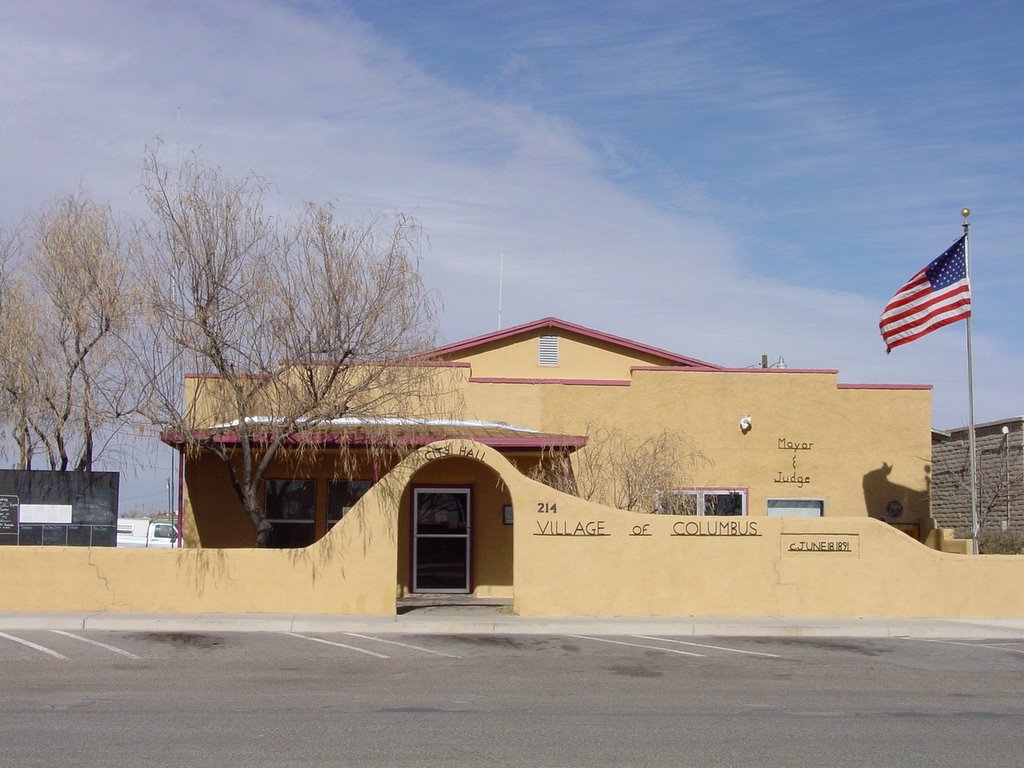
Above is City Hall and the courthouse. Inside the courtyard is where the purified water station is located.


This set of buildings are some of the remaining architecture from the early days of Columbus. We often eat in the Las Casitas restaurant here which is middle right.


This is Martha's Place, the B&B where we are staying. Each room has access to the balcony. The front balcony overlooks the desert and Palomas, Mexico.

Agua Purificado


In Columbus, New Mexico it is not recommended to drink the water. It is jam packed with flouride and tastes terrible. I have read, that the quality of water along the border is often a problem. In lieu of not being able to use tap water here, you will find the community at the pictured water station. This colorful faucet, directly outside the city hall, despenses purified water. When you pass by you often see people with several empty bottles coming by to fill up.

Wednesday, January 25, 2006

Pancho Villa


Columbus, New Mexico made its way permanently into history books on March 9, 1916. In the wee hours of the morning Francisco "Pancho" Villa and 1,500 of his villistas raided the town of Columbus, making this town the last place a foreign government successfully invaded the continental United States. They stole several horses and mules, killed civilians and U.S. military and burned down much of the town. 500 Villistas were killed in the raid. In response to the attack, the U.S. Army sent in 12,000 troops under Gen. "Blackjack" Pershing to seek out and kill Pancho Villa. Gen. Pershing and his army would spend the better part of a year searching for Pancho Villa in Mexico. Despite the large force and the use of combat airplanes (a first for the U.S. Army at this time), Pancho Villa was never captured by the United States.

Pancho Villa began his career as a bandit at age 16. After killing a rich hacienda owner who was trying to rape his younger sister, he escaped on horseback and spent the next several years as a bandit on the run, who successfully evaded the authorities. In 1910, Francisco Madero turned him onto politics and recruited Villa to the beginnings of the Mexican Revolution. Villa made the transition from bandido to revolutionary. With the help of the U.S., Madero and the revolutionaries were able to overthrow Porfirio Diaz who had ruled the country for 34 years. Five years later, it would again be the U.S. support for a different presidential candidate, Carranza and his regime, that would lead Villa to invading Columbus.

Pancho Villa seems to be highly regarded on both sides of the border, especially among the Mexican community. In Columbus, there is a state park, a restaurant, and a bar/cafe named after him. Considering there is not much else here, that is quite a lot of businesses with the name Pancho Villa.

Each year around March 9, a giant celebration happens on both sides of the border in honor of the day Pancho Villa raided and looted Columbus. In the next few weeks, men and woman on horseback will begin a 300-kilometer ride from the interior of Mexico to Columbus, New Mexico. They carry only what they need to eat and sleep under the stars along the way. I am told that this year will be especially impressive and they expect the number of riders to reach 1,000. The riders will barrel through the border and into Columbus reenacting Pancho VIlla's raid on horseback 90 years ago. I wish I could be here to see it! After the riders reach Columbus, the fiesta grande will begin!


Taken at the Pancho Villa State Park in Columbus, New Mexico

Monday, January 23, 2006

Las Chepas


We traveled by bus to Las Chepas, Mexico today. From the main square of Palomas, several school buses a day leave taking people to Las Chepas, which has become a well-known staging area for attempting to cross the border. The buses quickly fill up with people that to the innocent observer may think are taking a day trip to visit family. But, really they are in for the adventure of a lifetime and looking to leave their country and make the United States their new home. They are traveling to the last stop before making a run for the border. They carry very little with them, only a small bag, some water and snacks. Most are dressed warmly because they will undoubtedly spend several hours in the elements where temperatures easily dip into the 20’s at night. It took me awhile to realize the extent of what was happening before me. Our initial goal was to try to get permission to film on the bus, but I innocently thought that maybe people were going to Las Chepas for other reasons than hopping the border. But, as we talked to the bus drivers and people on the bus, it was clear that this was not the case. It took a lot of coercing for them to let us on the bus. The passengers on the bus eyed us wearily and with a touch of fear. It finally hit me after sitting on the bus for awhile waiting for word of departure and I got the chance to get a good look at the passengers. One girl in her early twenties sitting in the seat behind me grasped a bag with a blanket folded over the top. Her brother and his wife carried small backpacks as well with bottles of Gatorade stuffed in the side pockets. It was true. They had everything they needed to travel lightly in unpredictable circumstances. They carried on them all the possessions that they might need to start a new life in a new country. They had every intention of leaving Mexico and entering the United States illegally this very night. We ended up having to get off that bus and get on another bus because that one was going to be too full. The next bus was the same story. There were couples and young men all bundled up in warm clothes. As we rode for thirty minutes to the destination, I was overwhelmed with all sorts of emotions. One of the moments I remember most vividly is when we pulled out of Palomas and got the first full few of the border and the U.S. Nearly everyone on the bus looked out across the desert, eyeing their destination, their journey. Many said prayers in this same moment and touch the loved one next to them. I met many of them trying to break the ice and hear their story. Many understandably did not want to talk with us. In the end, we did not film anyone. But, I did have some conversations with people that will last with me for awhile. One man who I talked with named Augustine told me tonight was going to be his fourth time attempting to cross. Each time before he was caught. He spoke to me while his three buddies urged him to stop talking. This small group had no backpacks. Only groceries just bought at the store. They carried a shopping bag full of chips, several cans of refried beans and several one-gallon jugs of water. That is it. Then about fifteen minutes into the ride, we were pulled over by an orange truck that had police lights on top and Migracion (Migration) written on the side. I was worried. But, most people of the bus didn’t seem to be. Two uniformed men boarded the bus and began handing out pamphlets. What was in the pamphlets? There was advice on how to stay safe while migrating. What to do if lost in the desert. There was a reminder to bring food and water. And, there was a reminder not to get into the backs of vehicles that do not have ventilation. It advised people to put their hands up and not run if caught. The men advised everyone on the bus to carry water and dress warmly. Then they took down names on a voluntary basis to have on file in the event that something happens. Several people gave their names, age and place they come from freely to these two men. I was fascinated. This agency’s goal was to inform people of their human rights in an effort to minimize the loss of people’s lives.

Overall, the day was eye-opening, fascinating and draining all in the same go. As I get ready to sleep, I can’t help but wonder about the people I met today. Where are they right now? Are they hiding in a bush somewhere? Have they already been caught by the border control? Are they tired and pushing onward in the local mountain range just a few miles from where I am now? Did a lifelong dream possibly get realized tonight and they are in a safe house on the U.S. side of la frontera (the border)? This I will never know, but one thing is for sure, I will never forget the faces of the people I met today.


This stone monument marks the border of Mexico and the United States near Las Chepas


Sunday, January 22, 2006

Minuteman


The Minuteman Civil Defense Corps are a group of civilians that, being very dissatisfied with the government’s job of maintaining and controlling our borders, have decided to take on some of these duties on their own. They have garnered national publicity in the past few months as they have literally camped themselves along various parts of the U.S.-Mexico border in an effort to catch illegal aliens crossing into the U.S. and send them back without they themselves breaking the law.

As it turns, the Minutemen had an expedition planned for this past weekend in Columbus, New Mexico. Two of them ended up staying in our B&B. So, we made friends and the film crew was able to accompany the Minutemen on their border patrol last night. They caught eighteen illegals attempting to cross the border. The Minutemen started their expedition early in the day looking for tracks and popular paths that are traveled by illegals. After finding thousands of tracks in the day, the group separated out and patrolled various parts of a mountain range in between Columbus and Demming, New Mexico. The stakeout lasted for many hours and it wasn’t until almost midnight that movement was detected. The group of eighteen illegal immigrants made it past the border control and almost made it past the Minutemen. But, when they saw the Minutemen’s lights, the immigrants surrendered easily without much of a fight. The immigrants were men, women and teenagers, some kids thought to be about twelve or thirteen years old. They completely cooperated with the Minutemen and gathered together in a circle once caught. It is hard to say whether or not this was the first attempt for these people or if they had been caught before. Because, once caught either by Minutemen or U.S. border control, the border control processes the people, gives them a meal and then drops them back on the Mexico side of the border. Upon catching this group last night, the Minutemen alerted the official U.S. border control and waited for them to arrive. They gave them water while they waited and let them warm themselves by a fire. There is absolutely no contact between the Minutemen and the people they catch and they operate in a non-violent manner and cooperate with the official border control agents.

The Minutemen are a very interesting group. They are extremely conservative, yet anti-government at the same time. They feel their government is failing them in protecting the borders of this country, so are taking things into their own hands.

Pathetic produce sections

As I am all too familiar with in very small towns in the middle of nowhere, fresh produce is very hard to come by. I took the following pictures in the local General store here in Columbus. Pretty pathetic. As you can see, the most readily available produce is actually lard. Big turquoise boxes and buckets of it. The produce they did have was in a very sad state. I already miss being able to have a nice salad!


Arrival to New Mexico


My recent adventures take me to the SouthWest, a region of the United States I have longed to visit for a very long time. The town I am in is Columbus, New Mexico, a tiny border town about one hour West of El Paso. I am here to help with production on a feature length documentary film on life in these two towns that share an international border in common. I couldn’t help but be reminded of Nevada on my drive into Columbus from El Paso. Rock art lined the two-lane highway. A vastness spread as far as the eye can see. I was warned that if you blink you may miss the town. But, as the town came into view, it seemed much larger than everyone had said. Clearly, this was an oasis-like vision on the part of a weary traveler. Because, once inside the village, I realize that this town isn’t nearly what it seemed from a distance. It does have a ghost town-ish quality to it and I can see why the town made a listing on ghosttowns.com. A few old buildings from the 1900’s mixed in with dilapidated trailers and a few other more modern buildings make up this little village. It is not too unlike Gerlach, Nevada, although a bit more spread out. It has the usual desert small town amenities like a General Store, a gas station, a very large bar, two restaurants that close extremely early on Sat night and a church. There is a small theatre here called the Tumbleweed Theatre. How appropiate! The census stats record a population of approx. 1,700. But, locals say there are more like 500 people living here. We are staying with the Mayor and Judge of the town in their house, which is converted into a very charming B&B. For breakfast each morning we get a different version of huevos a la Mexicana, which are all divine! The mayor is also a local real estate agent and notary public. Her husband, as well as being the town judge, is assistant fire chief, buys and sells cars and sells real estate.

On the first night here, we went into Mexico for dinner, which is about three miles away. The border crossing in Columbus is the only 24-hour crossing along the whole U.S.-Mexico border. After a short drive to the crossing, we parked on the U.S. side and walked into Mexico. Immediately upon passing the crossing, you can feel the vast differences between these neighboring towns. Palomas, Mexico is a much more lively and bustling town. Cars filled the streets, some with bumping music. People crowded the sidewalks. A ghost town Palomas is not. The smell of grilled onions and peppers meshed with the diesel-fumed air. Bacon-wrapped hot dogs could be seen grilling on nearly every corner. Yum! We finally found the restaurant that was recommended to us and I think we were all glad we did. From grilled chicken to bull meat sandwiches to fresh guacamole and salsa, our meal was fantastic.


The red peppers are hung to keep away evil spirits. I love the pretty welcome sign on the jail.